Showing posts with label knowledge management. Show all posts

KM fallacies: Put usable tools in place, adoption will follow

The effort of running a typical KM initiative almost makes us want to believe that mass adoption will follow. Unfortunately, Ms.Adoption is not easily wooed. The launch of these initiatives are usually broadcast via company wide email. An increasing percentage of employees seem to be immune to such broadcasts (for good reason?). The early adopters, a smail percentage, use it for a few days and then their activity begins to dwindle. Adoption proceeds at an uneven pace and sometimes fails to reach critical mass needed for positive network effects. A year later, it's time for yet another initiative.

There are often genuine reasons why adoption doesn't take off. For example, the applications may not be easily accessible outside the company intranet. Or the applications may be slow to access from remote offices. Maybe people are just overworked. I am begining to wonder if there is another factor at play. I have observed it on the web and I suspect similar forces are at play within the enterprise: poor citizenship. Too many of us prefer to be passive consumers of public content on the internet. We don't produce or perhaps more importantly, curate existing content. Granted, there are some prolific producers of mediocre content via blogs, comments, tweets, and posts to public mailing lists or discussion groups (and a few prolific producers of really good content via the same channels) but they are more the exception than the rule.

Some examples of poor citizenship with respect to curating content:
  1. Not clicking "I found this review helpful/unhelpful" on a website that carries reviews (e.g. Amazon) or "This documentation was/was not useful to me" on a website that actively solicits feedback on documentation (e.g. many of Google's help pages)
  2. Not adding appropriate tags to images found on Flickr
  3. Not posting answers to unanswered questions that you ask in a public forum and later figure out the answer/workaround for.
  4. There are times when programmers struggle with a cryptic stacktrace at work and a web search points them to the exact cause. All because someone took the effort to blog about that issue. You often see a number of grateful comments at the bottom of such posts. Yet, when I overcome such a problem by myself, I seldom try to write a post about it.
It's not like we don't do it because we are against digital sharecropping. It might be that trying to be a good cyber citizen leads to yak shaving. I suspect that at least some it just boils down to a I-can't-be-bothered attitude. This attitude has tragic consequences for commons like public forums and wikis. Not many people seem to want to take the effort to contribute. But a system that fully relies on user generated content cannot succeed in the face of indifferent users. To some extent, cultural legacies determine our ability to effectively participate in a system that more resembles a gift economy. Incentive systems may help with adoption but they need to be tailored to the specific dynamics of the user community. All in all, adoption is a tough nut to crack.

Knowledge Management Fallacies: make it easy to import and attach documents

In order to migrate legacy content, one might resort to importing or attaching old documents into a newly fangled KM repository. This is a slippery slope. Importing/attaching becomes a crutch for users who are just too lazy to get used to authoring content in-line (using rich text editors). They continue to author all documents off-line. So what? Is there is a problem?

As Google has so successfully demonstrated, it is often the hyperlinks between documents that are more valuable than the documents themselves. Imported/attached content almost always lacks relevant hyperlinks to other documents in the repository. They hang about like dead limbs of a tree. What is worse, the offline versions often aren't discarded after import. They continue to evolve offline, unbeknownst to other users. They get attached to emails and soon no one cares about the orphaned version in the repository. The Google docs video captures this sitution well.


But of course, we love the power of our offline office tools and will continue to have powerful spreadsheets and presentations created using them. Sure, just don't tack them on as appendages to the one big repository. There is another repository better suited for offline content. It is called a file server. Better yet, use a web-enabled version control system backed by a file server. This gives us permalinks to the latest version of every document. Get them indexed by an enterprise search product. Oh, but our users aren't version control savvy. Come on. It takes fifteen minutes of training to understand update, add/edit, commit. After all, we all claim to be organisations of savvy knowledge workers, don't we?

Knowledge management fallacies: access control is key

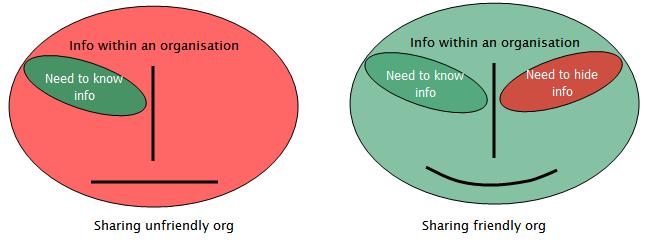
Organizations that are straitlaced about providing employees with unrestricted access to information cannot expect them to have a different attitude towards sharing knowledge with each other. A number of organizations share information with employees only on a need-to-know basis. For any given employee, very little (relatively) information falls in the need-to-know category. She is cut off from information that she might just be curious about. But wait, isn't this a good thing? Why distract employees with useless information? Fair enough, don't push unnecessary information to everyone. But don't hide it behind access control either. Someone might just find a serendipitous use for the information. A better approach might be to just hide the information that absolutely needs to be hidden and free everything else up. Rather than share on a need-to-know basis, protect on a need-to-hide basis.


Wikis are a great example of a technology that turns access control on its head. In a typical wiki, not only can everyone read everything by default, they can even edit anything. This feature used to invite ridicule in traditional departments. But the adopters mostly thrived. Hell did not break loose. Wikis have a robust cure for mischief. It is called "revert to earlier version". Authentication is essential. Authorization is less so. Author traceability discourages frivolous edits.

There is also the issue of scale. Preventive access control doesn't scale. What scales instead are mechanisms that offer cheap cures in case of problems. This is commonly accepted when we build applications for the web. Client server applications used to rely on a mechanism called pessimistic concurrency that tries to prevent problems while web scale applications rely on optimistic concurrency, i.e. taking corrective action in case of problems.

In a fast paced world you can't wait to ask for permission at every turn. We have an unwritten code that helps move things along at ThoughtWorks: Ask for forgiveness, not for permission. A friendly access control regime lowers barriers to participation. And participation is absolutely key to the success of any knowledge management effort.

Knowledege Management fallacies: Good organization is key

Even though keyword based search doesn't yield satisfactory results all the time, it often delivers better than manual organization.

Search trumps Navigation

Sophisticated Users
Others
Use application launchers like Launchy, GnomeDo or Quicksilver
Use hierarchical navigation from start menu or equivalent
(Coders) Use Ctrl-N (IntelliJ) or Ctrl-Shift-T (Eclipse) to open a class
Use hierarchical navigation of the Package/Project explorer
Use search engines to find information on the internet
Might prefer using something like Yahoo Directory to get to the information they seek
Use desktop search to find files on their hard disk
Always use the hierarchical file system explorer

Traditional hierarchical organization requires users to navigate through the hierarchy to get to whatever they are looking for. Such navigation is unnecessary in cyberspace and is painful for seasoned knowledge workers. Reliance on taxonomies is a relic of physical world thinking. Their importance is overrated in a digital medium.

Folksonomies don't replace search either. Being multidimensional, they are useful for finding 'similar content' after you have found the first one. Even then, it requires very good participation by the user community to be relevant.

Comprehensive organization is expensive and time consuming

It takes humans to put things in their place. :-) Correct classification requires some understanding of the subject. At a time when the quantity of content is growing rapidly, it is expensive to hire people with understanding of the subject to maintain a organization hierarchy. Relying on users to do this themselves doesn't work out well in my experience.

Lightweight, deferred organization is easy
One of the problems with upfront organization is that you have to come up with a scheme that is acceptable to most (if not all) users. Instead, it is easy to slap on a starting page or a table of contents later if you are using something like a wiki. When my project wiki began to get unweildy, someone just added a page called "Day one reading material" with links to several other informative pages (thus bypassing all notions of hierarchical navigation). New joiners to the project were simply directed to this page.

Just Ask Around
Asking people for information has never been easier. Corporate microblogging (micro-messaging) tools like Yammer (or just a company wide always-on chatroom) make it very effective and non-intrusive to ask questions like: "Can sometime point me to existing collateral for xyz service offering?"

Knowledge Management Fallacies: Repositories ensure that knowledge lasts longer than employees

My employer aims to be a home for the best knowledge workers. Several companies operating in the knowledge economy have similar aspirations. Yet, some of them fall shy of calling themselves a people dependent company. They would rather be process dependent (and people independent). Why? Because a process won't tender resignation and leave. Valuable knowledge may be lost when an employee leaves. Knowledge that is codified into a process is safe from attrition. However, this doesn't work in practice.

Knowledge keeps evolving. Codifying it into a process merely takes a (context-free) snapshot of evolution. Knowledge evolution can only happen in people's heads. The only way to preserve knowledge when someone leaves is to make sure that someone else knows the stuff well enough. However this knowledge transfer will fail if only attempted as a handover activity. Why? Because context is severely restricted during a planned knowledge transfer session. Knowledge sharing and collaboration has to be part of the work ethic of an organization. People need to buy into the fact that knowledge multiplies by sharing. In such a collaborative environment, knowledge silos are minimized if not eliminated.

'People dependence' is much more robust than 'person dependence'. A sharing-friendly culture helps move the dependency from person to people. A process and documentation driven culture moves the dependency from person to repository and knowledge atrophies in due course.

Sharing is effective via conversations, not so much via artifacts. This is because of the lossy nature of communication. Signal to noise ratio decreases as bandwidth decreases from face-to-face to phone conversation to instant messaging to email to finally an artifact in a repository.

Knowledge Management Fallacies: Well begun is half done, so let's begin by collecting content

This is the start of a series of posts on what I consider to be fallacies of knowledge management.

Some ten years ago, I used to be in the habit of printing good articles I came across on the internet. Sometimes, fifty pages at one go. But I wasn't able to keep up with reading all that I was printing. Yet, the act of printing and possessing the content seemed to offer some kind of reassurance. After all, I could read it anytime I wanted to. I realized the folly of my ways when I had to relocate for my next job. I had fifteen kilos of mostly unread, somewhat dusty, printed material. I was faced with the choice of dumping them (with all the associated guilt of wasted resources) or paying to transport them in the hope of catching up some day.

Then I grew a little wise. I started merely saving stuff to my hard disk instead of printing. I created a folder '2bRead' (still have it) and started growing my repository of wisdom there (or so I thought) - whitepapers, presentations, podcasts, videos, you name it. As the folder grew in size, I began to forget what was in there. I used to search on the internet for stuff I already had. Desktop search only partially solved the problem. The indexes began to grow huge and it didn't keep track of deletes well - I used to get false results. It also didn't help that I used to switch between operating systems.

Then came del.icio.us and I thought an end to my woes. Several bookmarks and tags later, I realized that I was spending more time bookmarking and tagging than actually reading and assimilating. It wasn't because I was an obsessive compulsive organiser (far from it). It was just that I often didn't have the time to study something when I came across it - it was much easier (and reassuring) to just bookmark and tag it.

Now I use a much harsher approach - read it then and there or forget it. You might be more disciplined than I am and might find this absurd but I suspect I am not alone. Individuals and organisations are struggling to keep up with the assimilation of information. So they tend to resort to what seems to be the next best thing - the collecting of information. However, this tends to be mostly a futile exercise. It might be more useful to focus on assimilation of information whenever 'information events' happen - talks, presentations, meetings. Focussing on recording and distributing (or storing centrally) in the hope of future assimilation is going to be increasingly ineffective.

Favour individuals and interactions over artifacts and repositories.
Favour context rich conversations over mostly context free collateral.

After all, we don't manage knowledge within digital repositories. We can only hope to curate information within them. Knowledge can only reside in people's heads. Efforts to improve knowledge should therefore focus on assimilation via collaboration rather than on curating information.