The fiddler of Kodihalli and other stories
Short stories by Sriram. Each story is around a thousand words. The creative commons pictures aren't mine. Feel free to comment on the stories you read. Suggest a different ending if you like :)
The Kite Ruiner
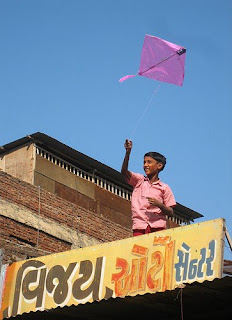
Image courtesy of MeanestIndian
Papa and Satish made a sturdy kite that Sunday. Satish did not know that good kites were made of light paper and bamboo strips. Papa was all for making use of materials available inside the house. He used soft paper from a old newspaper supplement for the kite skin. The frame needed bamboo strips but there was none in the house. There was a broom used to clean the bathroom floor. Out came two long firm sticks - a slightly thicker one for the spine, the other for the bow. Papa made it a point to attach a six feet long tail to the kite. "This Hanumanji ka shayput will keep your kite safe against rough winds", he told Satish. All that was needed now was about twenty five meters of string, nowhere near enough for serious flying but enough to convince a kid that he had flown a kite. Those days, you didn't have organized retail in India (even liberalization hadn't happened yet). Your only option for groceries was the local kirana shop. They used to pack provisions in brown paper bags with plenty of string to secure. The bags and strings weren't immediately discarded at home. One kept everything around for some later use in those days. Papa joined a number of these strings together with knots and asked Satish to wind it on a reel. The wooden reel had held tailoring thread once. "Now let's tie the kanni (harness) and we are all set", said Papa.
Up they went to the rooftop. It was the month of August when monsoon winds blow from the south-west. "I'll show you how to get the kite up in the air. Then it's all yours. OK? Now help me with a good lift-off.", Papa asked Satish to stand some distance away facing the wind with kite in hand. Satish heaved it up in the air when a gust blew. The kite shuddered against the wind for a second, then rose smoothly as Papa pulled the line. Soon Satish held the line and Papa asked him to give deel (release more string). With six feet of shayput (tail), it was a very stable kite. It wouldn't twist and turn or dive as other kites. Easy for newbies. In a few minutes, Satish learnt how to prod the kite upwards with a tichkie (twitching the string back), how to give deel to a rising kite and how to ghaseet (withdraw string) a drooping kite back to its height. Satish was thrilled. He kept giving deel. As it flew further, Satish's kite came within striking range of other fighter kites. The boys flying them from neighbouring rooftops smacked their lips as they saw this sitting duck of a clumsy kite. A cow caught unawares amidst a pack of hungry wolves. Before Satish or Papa could realise it, a red kite swooped down and cut their line.
Losing a kite in a pecchh (kite fight) is not unlike experiencing your loved one die in your arms in the middle of a dance. One moment your kite is alive and throbbing in your hand. You feel its life as it pulsates along the string. Your spirit soars along with its altitude, your body in step with its movements. The next moment you find yourself clutching a limp string. Absoultely lifeless. You can only watch in despair as you see your kite drift away. It sways this way and that, responding to every little whiff that touches it and you have absolutely no say in where it finally drops and rests. Young Satish didn't understand what just happened. How could his beloved kite simply float away? What had plucked at his line a second ago? "Papa, I want the kite back." he started crying. It was time for Papa to explain the facts of life as it pertained to kite flying in Bombay.
That evening Satish learnt what survival of the fittest meant. Bombay skies were one lawless space as far as kite flying was concerned. You didn't have to consent to a fight. You either fought back or tried to escape by withdrawing the kite out of reach of your predator. Escaping meant having to live with the title of darpoke (coward) for the evening. Papa told Satish about manjha (special abrasive string used for flying fighter kites). Manjha - the fangs of the fighter kite. Manjha came in different varieties - badami, gulabi, ghasleti, kala jadha, kala bareekh, pista bareekh. A good kite flier usually swore by his chosen variety. Lore had it that the best manjha came from Surat. Papa also told Satish about the dangers of manjha - cuts on the fingers, birds getting injured and accidents on the road caused by careless kite fliers running their lines through busy streets. But Satish would have none of it. His kite had been nonchalantly severed by a boy on a neighbouring rooftop. Satish had to have fighter kites and manjha now. He had to learn to fly them without a shayput. He had a score to settle.
And thus it was that Satish became a decent kite flier over the next few kite flying seasons. It wasn't an even playing field. Some rich kids would buy a dozen kites at a time. They would be back in the sky in no time after losing a fight. Not so for Satish. He was only given enough pocket money to buy two kites at a time. His lot was to sulk away after losing two fights in a row. Sometimes his kites would get tangled with trees or TV antennae (no cable TV then) and bring an ignominious end to his evening of flight. His manjha situation did not help either. The rich kids used to have entire firkis (bobbins) of Surati manjha. Satish had to do with five rupees worth of local manjha per month. After much wrangling and promises of studying well etc, Satish finally managed to purchase a real firki full of decent quality manjha and a half a dozen kites as a birthday gift. He had to dominate the skies that evening. To dominate the sky meant to be the only kite flying in the vicinity.
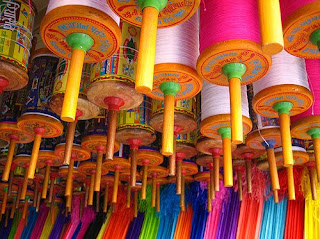
Image courtesy of MeanestIndian
In a span of five minutes, the skies over Satish had claimed four kites. A burst of activity in the middle of a routine evening of kite flying. The skies were clear momentarily. The spinning green kite was still stuck on the antenna, its flier still trying to untangle it with a combination of tichkies, pulls and releases. He could have just given up on it by pulling hard enough to break the line. But he did not have another kite to fly and the evening wasn't dark yet. The blue kite flyer was in mourning at having lost so much manja to Satish. He didn't seem in the mood to fly another kite. Satish began flying his sixth and last kite , a chequered one - red, blue, red and yellow. This was the moment he had dreamt of. To be the only kite flying after an evening full of fights. It would have been nicer had it been a victorious kite rather than a new one but Satish wasn't thinking of such niceties now. He kept giving deel, letting his four-square soar away, no challengers in sight. The breeze was in his favour, allowing his kite sail far without losing height on increasing deel . Satish wanted to see how much manjha his firki held. How far would his kite go if he gave full deel i.e. exhausted all the manjha in his firki. The manjha began to unwind rapidly from his firki. Some fliers have a companion who holds the firki. This guy winds the manjha back onto the firki when appropriate and keeps the manjha from twisting all over the floor. Satish had no such companion. He had just stuck one end of the firki into a flowerpot of dried mud. Someone had once tried a bit of gardening on the terrace and abandoned it after a while. The firki stuck out of the pot like a well thrown javelin sticking out of the ground.
Manjha uwound from the firki rapidly. You couldn't follow the unwinding with your eyes. All you could notice was fresh thin gashes appearing on the bob of manjha as the unwinding string exposed fresh string underneath. Satish watched triumphantly as his kite became a small red dot in the sky. Still no challengers in sight. He was having a good birthday. He could now see exposed wood from parts of the spine of his firki. A little more deel and he would be flying at full deel. He quickly glanced around to check there wasn't anyone trying to sneak up on him. All clear. Satish went for the last lap of deel - chik chik chik - the manjha went as it came unstuck from the firki. Color drained out of the firki rapidly as the last of the manjha went out. Satish hurrahed "full deel" and immediately gasped with shock as he realized that his hands no longer held any string. The last of the string was drifting away in front of his eyes, just over the edge of the roof. He rushed to the edge and lunged at the parting string desperate to get a hold. Missed. His chequered kite was so far and high that it did not even register loss of anchor on the ground. It just kept sailing taking the manjha along with it. Satish kept looking for where it would descend. He hoped to run across the streets and retrieve it then. But he had flown too far and high and that too in a stiff breeze. Satish kicked the firki out of the pot as he realized what had happened. The manjha had not been secured to the firki - it had just been wound without a securing knot. Satish had no clue if all firkis came this way or it was the fault of his local make. He had never flown full deel from a real firki before - only homemade reels. He always used to secure manjha to his reels by tying the first couple of windings in a knot with the start of the string. Only then would he wind the rest of the manjha. Wasn't that common sense for everyone? How could you simply wind it on a firki like that?
Dusk was falling. He had lost sight of his kite. He went out on the streets and ran in the general direction of his kite for ten minutes. He glanced at the sky in between buildings to see if he could detect limp string stretched across rooftops. A drowing man in the middle of a sea looking for signs of a lifeboat. He knew that his chances were zero. Kids on other rooftops would gleefully capture such an orphaned kite with a mile of new manjha. He would himself do the same. But he had to do the rounds today. He had to hope that no one else had seen it yet. He had to hope that he would magically come across its limp string. Hope died out after an hour of wandering. He also remembered that he was supposed to go out with his parents that evening. "Uncle, time kya hua?", he asked a passing man. The answer, "7:30" sent cold shivers down his spine. He was to be back home by seven. He could be grounded for a month for this violation. He faced the expected barrage of questions as he limped in home with an empty firki. "Where have you been? I thought you were flying kites from the roof. Where are your kites? Did you lose them all? What happened to all the manjha?" Papa was dismayed at hearing his tearful story. "Let it be. At least you flew them for two hours. Come, let's get ready to go out." Satish was too afraid to bring up the topic of a fresh supply of kites or manjha. His fears were confirmed a few days later when Mom put her foot down. "No more kite flying for you. You are becoming uncouth like the jhopadpatti (slum) kids. You need to focus more on studies. And try decent games like table tennis or cricket." Papa also got the ultimatum from Mom. "I warn you not to give any money for kites."
That was the end of Satish's childhood of flying kites. He vowed to resume his favourite hobby when he grew up and started earning his own money. Time flew. Satish went through school and college, graduated as a mechanical engineer and began working for a private airline as a maintenance engineer. He had forgotten his childhood dreams of uninterrupted kite flying. Doesn't this happen ever so often in life? You think you have to be somewhere in ten years. But the goals change during the journey. The original goals seem ill informed at the end of ten years. You now have a new idea of where you want to be in the next ten years. And so on. Satish hardly had any leisure, which he used for trekking in the Western Ghats and chasing girls. Occasionally, he would read a novel or two. On one such occasion, he happened to pick up Khaled Hosseni's Kite Runner. Childhood memories came rushing back as he read the vivid descriptions of kite fights in Kabul. He remembered that fateful birthday - relived the momentary joy of having flown at full deel and the immediate shock of losing it all. He had to do it again. Just for fun. It would be a fitting way to close the chapter on a childhood aspiration.
A few days later, Satish was back at his rooftop - six kites and a brand few firki of Surati manjha in hand. They cost much more now but hardly pinched a man of his means. The roof seemed much smaller than what he remembered. It looked shabbier. Satish marked the spot where he had desperately lunged at his last kite. All around him, new taller buildings had come up in place of the old ones. They stifled the breeze. Just this once for old time's sake said Satish to himself as he tried to get his first kite of adulthood up in the air. He was barely airborne for a minute when his kite got tangled in a cable TV cable running from a tall neighbouring building to his. He hadn't noticed these cables earlier. Now he saw the spaghetti in the skies above his building. They ran all over the place. Taller buildings acting as hubs and radiating out to the lower ones and from them to their neighbours. How could he ever get his kites through this maze to the skies beyond? He was reminded of crisscross burglar alarm laser beams guarding a precious exhibit in a crime thriller movie. These rooftop cables should be banned, thought Satish to himself, they should be asked to lay it underground, just like telephone and electricity. His evening of reunion with a childhood dream was ruined. Perhaps I'll try again when I am able to afford a house in one of those tall towers. No cables would interfere with his flying then. And thus was added one more reason to dream the dream of millions of Mumbaikars - to own a shiny new apartment in the metropolis.
written on: Wednesday, August 26, 2025 permalink
note: This is a work of fiction. All names and characters are fictional.
Comments:
Quite humorous !! seems like childhood memories have given birth to this story !
# posted by  Lakshmi : Tuesday, September 01, 2025
Lakshmi : Tuesday, September 01, 2025
I found it very cute. I just went back to my childhood memories of flying kite. Even now I try to do so, but feel grown up to fly a kite. Thanks for taking me to my memory lane.
Cheers,
Jyothi
Cheers,
Jyothi
# posted by Rights Culture for all : Sunday, February 21, 2026
Rights Culture for all : Sunday, February 21, 2026
Read "Kite Ruiner". Good story, and great ending. Your use of the language is, in a way, much like the use of a native speaker of the language, casual, unassuming and natural-sounding. Yet, the story has too many details, and shows that you work as a software engineer/geek in your daily life. And though its your own story that you've written, it lacks a warmth, if you understand what I mean. (Its otherwise called "empathy" for the character of Satish, no kidding). A pessimistically funny point of view from a serious-thinking short story writer.
# posted by Vinodhini : Friday, July 02, 2025
Vinodhini : Friday, July 02, 2025
I smiled all through while reading and never took a break. (btw I never intended to finish when I started to read). Having been raised in Delhi, I literally went though my own visual memories of kite flying, no surprises that your story was a near perfect match.
# posted by Puneet Kataria : Friday, October 18, 2025
Puneet Kataria : Friday, October 18, 2025

This work is licensed under a specific Creative Commons License.

Post a Comment