The fiddler of Kodihalli and other stories
Short stories by Sriram. Each story is around a thousand words. The creative commons pictures aren't mine. Feel free to comment on the stories you read. Suggest a different ending if you like :)
A cup of tea
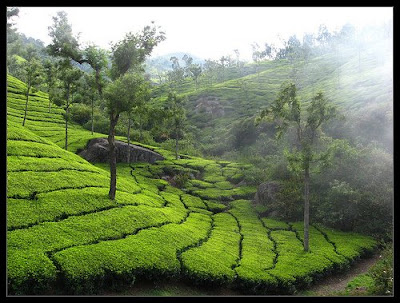
(inspired by Kalyan Varma)
Geeta worked for a technology company. It was a good company - bright people and an environment that afforded some intellectual stimulation. An enterprising colleague once decided to invite bright people from other fields to give talks at the office. On one such occasion, a wildlife photographer was invited. The photographer began to talk about conservation. He used his stock of photos to tell a story about conservation. Contrary to popular perception, he said, the biggest threat to our wildlife did not come from criminals like poachers and sandalwood smugglers. The biggest threat came from the common man - people like Geeta, you and me. How so? The photographer told the story of a cup of tea.
A lot of Indians drink tea. The basic ingredients for typical Indian tea are tea leaves, water, milk and sugar. Tea grows very well in hilly climes like Assam, Kerala and places like Ooty and Kodaikanal in Tamil Nadu. Forest land gets cleared to make way for tea plantations. Even though the forests don't get wiped out, they definitely get fragmented. Many kinds of wildlife cannot survive in fragmented habitats with sterile tea plantations between fragments. Their numbers dwindle. No single person can be blamed for this. Drinking tea is now part of our culture. Tea corporations merely fulfill society's need. The workers on the tea plantation toil hard just to make a living. As demand for tea increases, more land has to be brought under tea cultivation. In a country where unforested, uncultivated, fertile land is scarce, the casualty is the forest. No criminals here. Onto the next ingredient, water. Water, that giver of life.
Dams are built to quench the thirst of cities, irrigate fields and generate hydro-electric power. These artificial reservoirs often flood thousands of acres of pristine forest land to hold water. Widlife again suffers a double whammy of direct loss of forest habitat and severe fragmentation of whatever is left. An elephant that is used to ambling along a certain path in the forest now finds its track inundated. One can try putting up a sign that reads "Please use diversion. Nation on the move.", but as you might guess, the elephant won't be impressed.
Let's talk about milk. Milk comes from millions of small houses in villages each owing a few head of cattle. Milk co-operatives collect and process this milk before supplying it to the cities. In India, we don't have designated pasture lands for cattle grazing. The villagers have no choice but to herd their cattle into nearby forest or semi-forest lands for grazing. These limited lands get depleted by the grazing of ever increasing numbers of cattle. The soil gradually degrades leading to eventual loss of forest.
Sugar comes from sugarcane fields. Same problem of needing to put more land under cultivation to meet increased demand. Widlife does not give up these lands easily. Big cats (e.g. lepoards) move into the tall, well wooded sugarcane fields for hunting. There they come into contact with humans and get killed. No criminal activity here - it is natural for farmers to protect themselves and their family from these hunting cats.
So there you go. A simple everyday cup of tea has far reaching effects when sipped twice a day by a few hundred million people. So is the case with almost every other aspect of our consumption. Clearly, there are no easy solutions. This story was only meant to elucidate the problem.
That day, Geeta went home with a disturbed mind. Her dreams so far were built upon greater consumption. She liked to shop and dine at many of the upscale malls and restaurants. She was saving to buy a new car. Eventually, she had plans to settle down with a suitable husband in a nice comfortable house near the city and raise a couple of children in due course. She realized that millions of other young people like herself were dreaming similar dreams. Based on what the photographer had told, the realization of all these dreams would have a severe cumulative impact on the ecology. And humans would not be insulated from the impact. But then, maybe the photographer was being alarmist. Surely, human ingenuity would find a way out. Genetically engineered tea might increase yields hundred fold. Cheap desalination technology could solve water problems. Artificial milk substitutes could be developed just like artificial sugar substitutes that are already available. Geeta wasn't satisfied with these thoughts. She needed reassurance. She talked to her friend Deb about it.
Deb was a researcher in artificial intelligence. Over the years he had built a fabulously capable bot. He called it Debot. Debot was capable of natural language and speech processing. Over the years, Deb had fed it with nearly the sum total of human knowledge - scanned copies of important books from his university library and the output from a spider that crawled the internet. Deb asked her to come over during the weekend for a chat with Debot.
Debot listened to Geeta's story. Geeta explained her dilemma and asked Debot if it saw technology being able to solve these problems. "A lot of people are under the delusion that technology can rescue mankind." replied Debot. "All technology can do is to make things cheaper or more efficient. e.g. an automobile that can go 100 miles per litre of petrol. Technology cannot help if you fritter away the savings by consuming even more. This effect has been observed in the past and it is called Jevon's effect. Basically the savings from better technology are more than offset by increased consumption. There is no escape unless you limit consumption. But then, modern economic models would fail because limiting consumption means limiting production and thereby economic growth."
Geeta took a while to digest this answer but it did seem to make sense. On the other hand, it's implications were wholly unpalatable. "You don't mean that the only way to survive is to put a cap on human progress, do you? For over three thousand years, human civilization been marching steadily along. We used to be hunter-gatherer savages until we invented agriculture. We have made great advancements in science, medicine and the arts. Where we are today is an inevitable progression from where we started." Geeta paused. Debot surmised, "Hmm, since it is difficult to lay a finger on any single event (e.g. invention of the steam engine) and say that is where humans screwed up, one could say that the situation today was inevitable given where you started long ago." "Hah, that's utter rubbish." came the retort from Geeta. "You seem to be implying that hunting and gathering is the only sustainable way of life." "No. But it is certainly unsustainable to live at odds with the laws of nature." said Debot, and over the next two hours, went on to explain Ishmael's teachings about the law of limited competition.
Of course, these teachings were completely new to Geeta - she sat as if she had just heard a fantastic tale of Sindbad the Sailor. Then she said, "Hey Debot, I am feeling depressed and helpless. Say something nice." Debot thought for a few hundred milliseconds and said, "I'll try but it is up to you to feel good about it. You know this collective rape of the earth by humans is going to stop soon. On an ecological time scale that is. Humans are accelerating towards their own extinction. Once humans are fully extinct, the earth will begin its journey of recovery. In due course, the earth will be restored to its natural splendour. Until the next catastrophe that is. The rise and fall of modern human activity will be an invisible blip on earth's timeline. After all, what is a few thousand years of madness in a lifetime of a few billion years. It is something like 0.0001% of the time. The earth will be fine, don't worry." concluded Debot. "You are heartless." sighed Geeta. "That is a fact." quipped Debot.
"I'm not in the mood for your stupid jokes. Is there a switch somewhere that will make you a little positive?" pleaded Geeta. "Ok. Here comes constructive advice. Limit consumption. Try going carbon neutral. A lot of nouveau-riche people in the BRIC countries think that it now their turn to lead the hedonistic life. Such thinking will only accelerate your downfall. Rediscover local self-sustaining community life. Centralization may be efficient but it concentrates power, reduces visibility to real problems and makes common people feel helpless. Local communities are a great way to decentralize. Reduce your dependence on government and corporations. Break free of the shackles of modern economy. Breathe easy. Save the world. Good luck." At that moment, there was a power cut and Debot went to sleep.
written on: Monday, December 01, 2025 permalink
note: This is a work of fiction. All names and characters are fictional.
Comments:
Sounds like interesting management fiction. Words such as "quipped", "pleaded", "sighed" lend an air of frivolity, though.
# posted by  dynamicproxy : Friday, March 20, 2026
dynamicproxy : Friday, March 20, 2026
@dynamicproxy - 'management' as in planet mis-management by us? Thanks for reading.
# posted by  Sriram : Sunday, March 22, 2026
Sriram : Sunday, March 22, 2026
Did you have a power-cut (read: Writer's Block) towards the end and decided to taper off vaguely, without finishing the story? Seems like it. Nice thought behind it, but the story doesn't hold water, or rather, it holds too much - like a weak Cup of Tea.
# posted by Vinodhini : Friday, July 02, 2025
Vinodhini : Friday, July 02, 2025

This work is licensed under a specific Creative Commons License.

Post a Comment